1960s – BRITISH INVASION AND PSYCHEDELIA
The 1960s marked a decade of profound social and musical upheaval, often categorized as the transition from Rock & Roll to Rock music. This era was defined by two major, interconnected cultural forces: the explosion of British bands onto the American
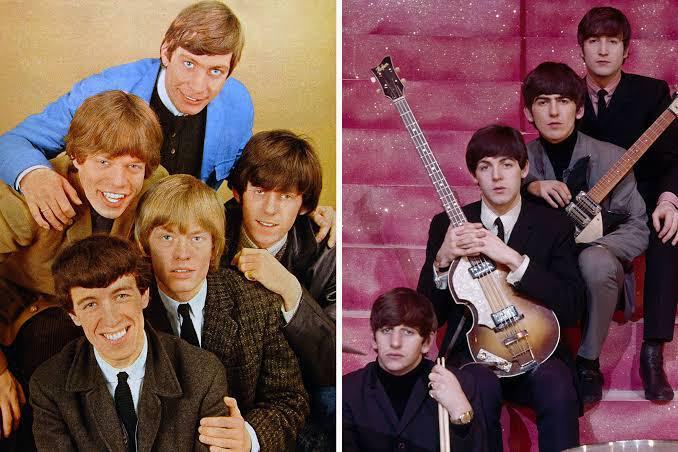
The Beatles and The Rolling Stones: Redefining Pop and Rock
The British Invasion began in 1964 with the arrival of The Beatles in the U.S. This movement brought a wave of British youth-driven rock and pop groups who were heavily influenced by American R&B and Rock and Roll, but presented it with a fresh energy.
- The Beatles: Initially famous for their clean-cut image and catchy pop songs ("Beatlemania"), they quickly evolved. They experimented with complex studio techniques, classical orchestration, non-Western instruments, and advanced harmonies, moving pop music from simple rock and roll to serious art (e.g., Sgt. Pepper's Lonely Hearts Club Band).
- The Rolling Stones: Positioned as the 'bad boys' counterpart, the Stones maintained a rawer, blues-based sound. They solidified the rock band format and emphasized a tougher, grittier approach, keeping the spirit of R&B alive and setting the standard for hard rock.
Motown and Soul: The Sound of Young America
Concurrently in the US, Motown Records in Detroit and Soul music were dominating the charts, largely driven by African American artists.
- Motown: Founded by Berry Gordy, Motown developed a distinctive "sound" that blended R&B, gospel, and pop influences. It was characterized by melodic hooks, prominent bass lines, heavy use of tambourine and drums on all four beats, and sophisticated vocal arrangements. Artists like The Supremes, The Temptations, and Marvin Gaye achieved crossover success, breaking racial barriers in pop music.
- Soul: More gospel-rooted and emotionally intense than Motown, Soul music (led by figures like Aretha Franklin, James Brown, and Otis Redding) focused on powerful, expressive vocals and raw energy, embodying the depth of Black American experience.
Psychedelia and Counterculture
As the decade progressed, an increasingly experimental sound emerged, tied to the social counterculture movement and the exploration of altered states of consciousness.
- Psychedelia: This music aimed to replicate the experience of psychedelic drugs through sound. Musical characteristics include long instrumental solos, abstract lyrics, complex studio effects (like phasing, tape loops, and backward recording), non-traditional instrumentation (sitar, tabla), and the frequent use of modulations (changing keys mid-song) to create a sense of journey or disorientation. Bands like Pink Floyd, The Jimi Hendrix Experience, and The Doors were key figures.
- Counterculture: The music served as the soundtrack for the anti-war movement, civil rights, and social liberation, emphasizing themes of peace, love, and spiritual exploration.
Extended Chords and Modulations
The harmonic language of the 60s grew significantly more complex than the simple I-IV-V of early Rock and Roll.
- Extended Chords: Instead of simple triads (root, 3rd, 5th) or seventh chords, the 60s saw the widespread use of chords that include the 9th, 11th, and 13th degrees (e.g., Cmaj9, G13). These extended chords add a richer, softer, or jazzier texture, especially prominent in the more sophisticated pop of The Beatles and Bossa Nova-influenced music.
- Modulations: Key changes became a common tool, especially for dramatic effect in ballads or for creating complex structural shifts in psychedelic and progressive rock. These shifts often employed secondary dominants or chromatic movement, signaling a new level of harmonic sophistication in popular music.
Question of the week
Which note is an 11th higher than a D? You can invent your own question and investigate from that point.